Whether it's your first year or your fifth year, these tips from trumpeter Alex Noppe will set you up for a great year of exploration, learning, and growth!
1. Go to class and do your homework
Most students that fail classes do so because they don’t show up and they don’t turn in assignments. Too many of those end up paying for 5th and 6th years of college! Don’t let one missed class or assignment spiral into many more.
2. Use your professors for help
That’s why they’re here – they like teaching and helping students!
Never be afraid to ask questions, whether it’s about class material or anything else.
3. Use your fellow students for help
As much time as you spend around the faculty, you’ll spend way more around your peers. Learn from them. Ask questions. Practice with them. Most older student love to help out freshmen with advice and ideas.
4. Practice.
A lot. Every day! This is your job right now – to become great at your craft. Nothing else is nearly as important. You don’t get to take weekends and holiday breaks off from practicing any more. The best thing you can do is actually put your practice times in your calendar, and plan on multiple shorter sessions throughout the day. Mental fatigue leads to poor practice and very few people can remain mentally focused on one thing for hours at a time.
5. Use the little breaks in your schedule
Most music majors have tons of shorter classes and rehearsals, often with 20-40 minute breaks between them. You’d be amazed at how much you can accomplish in those short breaks, whether it’s a hyper-focused practice session, theory homework, or meals.
6. Be a good person to everyone around you
This one is really important. Music school isn’t a competition – it’s collaborative and we all can get better together. Your reputation building begins right now, and many of the connections that you make while in college will be critical to your professional life down the road. Don’t gossip. Don’t cut people down. Assume that anything you say about somebody else will probably get back to them. Both positivity and negativity are extremely contagious, but positive people have happier lives!
7. Try out new things
One of the best things about college is the incredible variety of opportunities and experiences that you will encounter. This is the best time to explore new fields, take new classes, learn new skills, and do things that will challenge you. I can guarantee that you will leave college a different person than when you started, and you never know what unexpected opportunity might set up you on the path towards the rest of your life.
8. Be smart about money management
Remember that you have the rest of your life to work a job. This might be your only chance to be a college student. Save money on the things that don’t matter so much (fancy coffee, expensive cars, the newest cell phone) so that you have it for the stuff that does (extra lessons, a study abroad trip, high quality instruments). Small amounts of student loans are probably worth it if it means that you don’t have to spend your precious practicing/homework time working a minimum wage job.
9. Be healthy
Go outside. Drink more water and fewer energy drinks. Exercise. Don’t eat Taco Bell for every meal. Try to find some time to take care of yourself.
10. Remember that your worth as a person is not measured by your music
In music school, you’ll experience the highest of highs and the lowest of lows, sometimes within the same 5 minutes! You’ll have successes and failures, but you don’t have to define yourself by either. Every audition or performance is only representative of just your music making at one specific
snapshot in time, not a value judgment of you personally.
As music majors, you get a tremendous opportunity to spend a few years (or your entire life) doing
something that is deeply meaningful to you and those around you, and making our society a better place to live in. Enjoy it – it’s going to be an exciting ride and tons of fun. Have a GREAT year!!
Sunday, September 4, 2016

Friday, August 14, 2015
Inspiration
Every now and then I need a little boost or inspiration to help get me back on track. I thought I'd share some of my favorites:)
I hope you enjoy them as much as I do!
 |
| Always a good reminder:) |
 |
 |
| A great way to start a Monday! |
 |
| One of my favorites... |
 |
| A decision worth making! |
 |
| New way to look at bravery:) |
 |
| Something to be mindful of.... |
 |
| Sleeping Bear Dunes Bay off of Lake Michigan:) |
 |
| This needs no explanation:) |
 |
| A great quote to remind me what my job is when I'm performing. |
 |
| Great perspective:) |
 |
| I've always loved this quote. And finally.... |
 |
| :) Have a GREAT DAY! |
Thursday, June 4, 2015
Stay the Course
10,000 hours. That’s how long “they" say you need to work at something to become a master. I have been practicing for over 15,000 and I don’t feel like I am a master. Maybe I should quit? Hahaha, no way.
If you have read my previous two posts, you have noticed a trend (kudos for being able to recognize a trend over 11 months). I am constantly thinking about how we as musicians and humans improve. To me, this is of the utmost importance. Setting and achieving goals is great and totally necessary but what happens when you achieve those goals? Where do you go? What if you only have long term goals and you are finding them impossible to reach?
It’s all about the journey
I recently read an article in an airline magazine about a guy who is putting the 10,000 hours theory (please know that that is all that it is) to the test. He had never played golf and decided he wanted to master the sport in 10,000 hours. His plan was 6 hours per day, 6 days per week. I hate to disappoint you but, at the time of the article he was only through 5,700 hours so we probably won’t know the outcome for another few years. For him, 6 years has turned into 8 years. But I digress! Or do I?
There was a great point in this article and that was that the subject of this experiment will never view himself as a failure because this journey has been transformative. His family and friends agree. He ran into some challenges that got in the way of his project and instead of trying to become a master of golf, his new mission was simply to finish the project. This is the point upon which I would like to focus.
Let’s forget the fact that he started as a beginner and a day after this interview took place he shot a 74 on a pro-level course (most courses have a par between 70 and 72)! Let’s focus on the fact that in trying to get to 10,000 hours and mastery of something, his biggest challenge is staying the course even when 6 years turns to 8 which may even turn into 10. This happens to all of us to some degree, I believe.
Wha, what happened?!?
It is easy to be into something when the learning curve is steep and we are quickly getting tangibly better. But at some point we reach a level where the change isn’t so obvious and the curve has all but leveled off. Our choice when we reach that level (or imagined plateau) has a huge impact on our future.
The process becomes tedious, emotionally draining, and downright frustrating. The cool thing is that all of that happens because we are better. I use the phrase, “I had my ears opened,” when I talk about my time in grad school. What used to be good isn’t good enough anymore.
Push record AND play (not at the same time though, unless you’re using a tape player…)
This is why I love technology. Recording yourself is easier than ever and it can help give perspective. I often hear people say, “I used to be able to do this much better, didn’t I?” Thanks to modern technology, you can be your very own fact-checker. Chances are, you are wrong. IF you happen to be right, then you need to reexamine how you are practicing.
I record almost everything I do. But even more than that, I record myself playing standard solos, excerpts, or etudes and, yes, I actually do listen to them. Many people skip this step which completely defeats the purpose of recording in the first place. Before I even go back to listening, most of the time my thought after I play something is, “huh, it was never that easy before.” That is an awesome feeling and it helps let me know that I am doing the right thing. Also, when I am going through a rough patch, it is good to go back and listen to recordings and remind myself that I am a good trumpet player.
I do the same thing with Mirari recordings. We often perform pieces for more than one tour and so I get to review recordings after each tour and see where I am and what needs work and also recognize that we are creating awesome music. That helps me become a more confident performer. That helps me stay the course even when the going gets tough.
Things to remember (you could try doing them too!)
I can boil this whole post down to a handful of points:
1- Put your time in. Do everything you can today to be better tomorrow.
2- Record yourself often.
3- Listen often and figure out if you’re on the right path.
4- Acknowledge and celebrate progress. If you don’t, you might be on the fast track to burn out.
5- Persevere through the tough times. Just keep moving. Sometimes it may be forward and sometimes it may feel like you’re going backward. The important thing is that you don’t stop moving. Adjust your clock, set more goals, and keep moving.
Best of luck!
Matt
Saturday, May 16, 2015
The Commissioning Process…Where to Start??
The idea of
bringing a new piece of music into the world, or having someone write you
something specific, is a very exciting notion.
A notion, that up until a few years ago, I never thought would be a
reality. Commissioning or hiring a
composer seemed to be a daunting task….who do you ask? How do you find composers? How to you pay for the piece? As a quintet, Mirari does quite a bit of
commissioning, which is decided on and paid for by the group. As an individual it can seem a bit harder to
pull off. Through sharing my individual
experiences commissioning new works, I
hope to shed some light on what
can seem like an intimidating process.
Why Commission?
Commissioning a
new piece of music can seem like a daunting or confusing task, it definitely
seemed that way to me. On top of that,
for many people, the idea of commissioning a new piece of music is
expensive. As musicians ourselves, and
especially when early in our careers, we’re not exactly rolling in money…but
I’ll get to that in a bit. One reason to commission is to simply bring new
music into the world. The tuba (the
instrument I was commissioning for) has a relatively small body of music,
especially when compared to instruments
like the violin or flute. It was only in
the past 50 years or so that the tuba has been taken seriously as a possible
solo instrument, with composers writing for it in a solo setting. As a result the compositional options seemed
endless.
Another reason
to commission, which didn’t occur to me at first, is composers (for the most
part) WANT to work with performers, and the performer-composer relationship is
a unique one in the music world. Unlike
performing musicians and conductors, composers don’t have the same opportunities
to collaborate with other musicians. In
addition, commissions are one way that composers earn money for what they
do…just like performers earn money by performing, composers earn money by
composing. As a musician I like to
support fellow musicians in their craft.
Who to commission?
Unless you
already have an idea of whom you’d like to commission, the first task is
finding the composer. This can also seem
daunting at first, because unless you know a composer and his or her music
well, you may be unsure as to whether you’ll enjoy working with them and be
happy with the end product.
The internet is
a super useful tool for this. The first
time I commissioned a piece I started my search by going to a number of
different composer websites and listening to samples of their music, trying to
get an idea of what each composer and their music was about. Since this was going to be someone I was
going to be collaborating with, I also wanted to make sure that the individual
wasn’t going to be a pain in the behind to work with. Once I started narrowing my list I spoke to
people that knew the composers on a professional or personal level to get their
take on the composers as people.
I considered a
variety of composers from around the country, taking into account their
location, their musical language, what instrumentation they had already
composed for, and their current popularity and success. I wanted to commission a composer that was
clearly well thought of but not too big of a name for cost reasons number one,
and also because I wanted to promote a composer that wasn’t well known in the
tuba world. I didn’t want another work
written for tuba and piano, so specifically looked for composers that worked
frequently outside that box. In terms of
location I hoped to find a composer within driving distance to have the ability
to work with them in person. Finally, I
thought it would be great if the composer had already composed for tuba in a
solo or chamber setting, as then they would be more familiar with the
instrument.
What about the $$?
Just like there
are a variety of ways of finding and working with composers, there are also a
number of ways of funding a commission.
Commission fees vary based on a number of factors, including composer
experience, your personal relationship with that composer, length of the piece,
and complexity of the instrumentation (i.e. it’s cheaper to commission a piece
for a solo instrument over a concerto with orchestra). I found that most composers charge a certain
fee per minute of composed music then adjust that based on the other factors
mentioned.
Young and up and
coming composers want to get their music out there, and as a result often have
a much lower commissioning fee and are a great way to go if you are on a tight
budget. I commissioned a work for
trombone, tuba, and recorded sound with fellow Mirari member, Sarah. The composer (Inez McComas), Sarah, and I
agreed on a unique commissioning arrangement.
Inez considered herself to be an up-and-coming composer. As a result, she believed it was more
important and more valuable for her works to be heard in performance than to
receive a monetary fee. With this idea
in mind, Inez suggested that for each minute of music composed, Sarah and I
would owe her one live performance. The
piece she composed, called “The Middle Pigeons”, ended up being 7:15, and as a
result we owed Inez at least 7 live performances of the work.
A quick side
note about another way to find and fund a commission, and that is having the
composer find you. After performing a
duo recital a student composer approached Sarah and I, asking if she composed a
piece for the duo, would we be willing to program it in future recitals. She has composed a few pieces for tuba before
and plays horn herself. We said yes, and
since then have been in contact with her regarding the nature of the piece,
typical audiences, and extended techniques that we or are not capable of, our
personal ranges, etc.
Besides the up
and coming composer route there are many other ways to fund a commission, and
my other personal way of funding a piece was through a consortium.
Funding my commission
of Asha Srinivasan, Professor of Composition at Lawrence University, was a much
different process. During our initial
meeting, she and I agreed on a commission rate of $3000 for a 10-minute
work. She based this on her per minute
rate. Keep in mind though, that many
well known composers will charge upwards of $1000/minute. Remember….just like we as performers have to
make a living do what we do, so do the composers! Think about high-level performers charging a
high fee…composers are the same. Our
product is performance, while theirs is the music they produce for us to perform.
Back in the
early stages of finding and selecting a composer I had an idea that whatever
the commission fee ended up being would be too much for me to cover all on my
own. $3000 was indeed more than I
personally had, so I decided to establish a consortium of tuba players. I had heard of consortiums before, but had
never participated in one. Initially I
had hoped to create a consortium with a minimum of eight other members. From May through June of last year I contacted
around 40 tubists, explaining the project and the consortium, trying to
determine the level of interest in a project like this from each potential
member. I received a positive reply from
seven individuals.
All of the
administrative and emailing work was time consuming, and as you can see, in the
end I received a positive reply from less than a quarter of the people I
contacted. At first I thought, wow, what I waste of my time, contacting all of
these people. But even though I didn’t
receive a monetary contribution from every person on my contact list, making
those contacts did have value. Many of
those that I contacted I’ve never had any connection to before. This consortium has allowed me to connect and
network to musicians around the country, something that could prove invaluable in
the long run. And with the seven that
did participate in the consortium, I’ve established and/or continued to build a
stronger relationship.
Each member of
the consortium contributed $250 and in return they received a copy of the work
and participation in an exclusivity period of one year following the premiere. I created a consortium agreement form for
each member to sign and return with the $250 fee.
Besides paying
through performance or establishing a consortium there are numerous other ways
and options to fund a commission, I’ll go over a couple others. First, grants. When I began exploring options to fund Asha’s
commission and my CD project I met with the grant librarian in the Memorial
Union Library….and was completely overwhelmed.
Through my meeting with her I learned about the giant databases where
you can search for grants for an endless variety of purposes. After a day of sifting I decided that for
searching for, and the even more rigorous process of applying for grants, was
too much for the scope of that project.
That said, the grant library is a fantastic resource where I learned a
great deal. I hope to someday soon get
my feet wet with grant writing, as it is an enormous resource.
Another funding
option is using Kickstarter, an Internet and social media based source to fund
creative projects. I created a
Kickstarter project to help fund my CD recording process, but it can also be
used to fund a commission.
Connect, Collaborate,
Build Relationships
One major
difference between working on a piece you’re commissioning and most other works
is the fact that the composer is alive.
I know, this seems very, very obvious, but it is a fact that is often
overlooked. In the past I’ve played a great deal of pieces where the composer
is still living (due to the young age of the instrument) but I’ve never made
any effort to contact the composer. The
first time I made a real effort to contact a composer was for my first CD
project, URSA. For that project I made
some sort of contact with every composer, and if possible, I strongly encourage
other musicians to do the same. Building
a relationship with a composer beyond the notes on the page can add a new
element of depth and understanding to the meaning of a piece.
If you have the
opportunity to work with a composer on one of their pieces, DO IT! And keep an open mind. The composer wrote the piece hearing it in a
particular way, so they will most likely have suggestions for you, which will
hopefully aid in your understanding and preparation of the work, but at the
same time, if they also are keeping an open mind, they may adjust the music to
reflect something they like that you’re doing.
A few months before recording the title track of my CD, I had the
fabulous opportunity of working with Libby Larsen, when she came down to
Madison from the Twin Cities to work with pianist Kirstin Ihde and me on her
tuba concerto. Throughout the coaching
Ms. Larsen made a number of suggestions to Kirstin and me, but more than once,
when she heard something that we did that wasn’t marked on the page, that she
liked, she marked it in her score to later give it to her publisher for a
future publication of the piece. Once
again, composers want to work with performers!
When
commissioning music that relationship becomes even more personal. Working with a composer through a commission
becomes a true collaboration, one that can be incredibly rewarding for the
composer and performer alike.
-Stephanie
Thursday, April 16, 2015
Nervous When you Perform? You're Probably Breathing Too Much!
Wait, what? That goes against everything we've ever been taught as brass players! Let me explain. You know the feeling when you are performing and start to feel anxious? Your heart rate quickens and so does your pulse. Your breathing gets shallow and you start to take a lot of them. But somehow, you constantly feel out of breath. Here's what's happening:
Consider a normal breath under relaxed circumstances. You fill your lungs completely full of air, which is made up of slightly less than one-quarter oxygen and the rest nitrogen, carbon dioxide, and other gases. We'll call all that stuff carbon dioxide for now because that's what most people understand. While you are playing, your body uses most of the oxygen for, you know, staying alive. The carbon dioxide is mostly blown into your horn. Once you're out of air, you take another breath and the cycle repeats itself.

But here's what happens when you're nervous. Your heart rate quickens, causing all sorts of problems but most importantly, you take in extra breaths before you are fully out of air. So here's what we end up with. You take your first breath and your body uses the oxygen. You blow some of the carbon dioxide into your instrument. Then you take another breath, but this time you don't have your full lung capacity to work with because there's still some carbon dioxide left in there. Again, your body uses the oxygen, you blow some of the carbon dioxide into your instrument, and then take anther breath too soon. Now you have even less lung capacity to work with, and again, your body uses the oxygen. At this point, you have a lot of carbon dioxide built up in your lungs and less and less oxygen to work with. So you feel out of breath and continue taking too many breaths because your body is reporting that it's out of oxygen and panicking. This is a dangerous cycle when you are already nervous!

You're taking more breaths but getting less oxygen! So what are some solutions to this? First of all, the easy solution to deal with this situation when it happens to you:
BLOW ALL THE AIR OUT OF YOUR LUNGS
Find a spot in the music when you can exhale completely and take a fresh breath to re-oxygenate. Try this right now—blow all the air out of your lungs and take a nice big breath. Do you feel how it instantly gives you extra energy? This works pretty much all the time in performance.
Here's the way to avoid this problem in the first place:
PLAY WITH LOTS OF AIR SUPPORT AND LONG PHRASES
Most of us play with a weak and wimpy sound when we get nervous. Make sure to keep putting lots of relaxed air into your instrument. And even though your "fight or flight reflex" is telling you to take lots of extra breaths, save them for the ends of phrases, or when you're truly out of air. This requires some mental discipline but it can be practiced. Try running up and down the stairs a few times and then playing some long lyrical phrases when you're already out of breath. The feeling is remarkably similar to what you feel when you're experiencing performance anxiety!
These techniques won't completely cure nervous performing, but they will get you one step closer. Good luck, and let me know how this works for you!
-Alex
Monday, March 2, 2015
Your Brave
Mirari just had our spring weeklong tour presenting master classes and performing concerts at several universities and colleges in Missouri. We met, worked with, and got to perform for many smart, engaging, and fantastic performers and teachers! Obviously, this is one of the amazing perks of this job, but I’m also realizing, the place I find myself most fearful – the horn in my hands performance arena.
Recently, I got a tattoo. For those of you who know me, I’ve been thinking about this for several years now. I finally did it a few weeks ago and it has been a decision that I have not second-guessed and/or regretted, ever (for those of your who know me, this is also a big deal!).
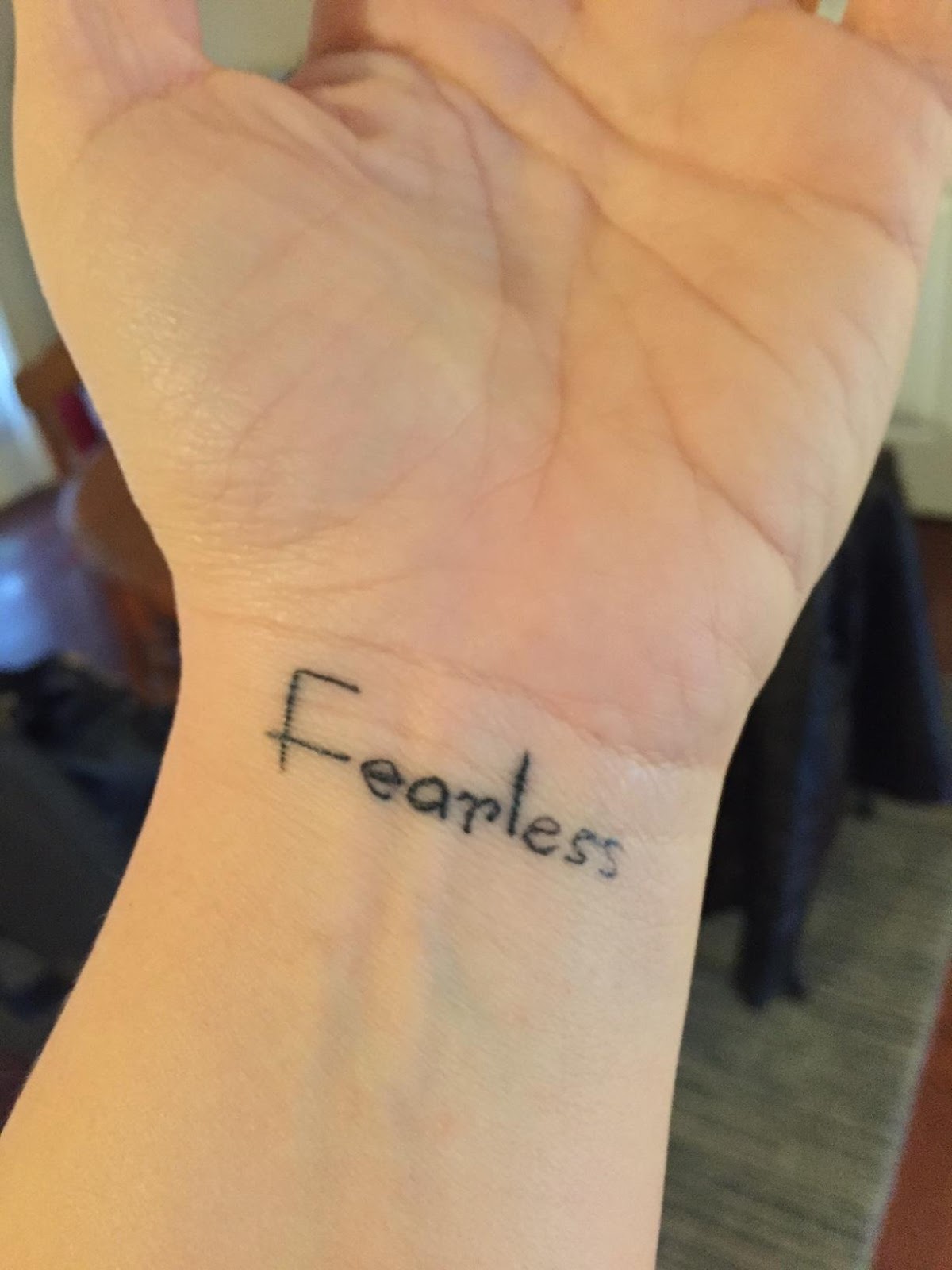
I have been on this Fearless path for about 9 years now (WOW!). I’ve had ups and downs, highs and lows, and have experienced a myriad of emotions on this Fearless ride. Luckily, throughout this process I have made amazing friends and acquired an arsenal of Fearless resources all of which have helped me become a better performer/story teller when on stage.
For each performance previous to this week, I had my inspiration sheet, notes of encouragement on my music, countless phone calls to and amazing advice from Jeff Nelsen (THANK YOU!) and many other friends to get my mind in the “right” place - to get me in the zone. During this past week, I felt the symptoms of nervousness start to invade my body (of course, stemming from my own thoughts) as we sat down to start our first concert. My mind was filled with too many options. What if I can’t get my lips to respond because they are chapped, and I’m dehydrated, and tired from a long day of rehearsal? What if I can’t make it through this performance? What if I can’t get notes to speak? What if I freak out and am out of the zone? I had 95 “What If” options. As I took my first breath of the performance, I looked down at my left wrist and saw FEARLESS emblazoned on my skin.
It was an instant reset. I was immediately calm, focused, and ready to share music/stories not only with the rest of Mirari, but with the audience, as well!
Fearless training has been such an integral part of my life over these past 9 years, that I didn’t need a paragraph explaining what it was, what it entailed or have someone encourage me to do my best to know exactly what I needed to do. Fearless is something I am; it’s in my being (as it is for everyone). Fearlessness comes from within, not outside, myself. Just like you learn from your teachers, process what they say, put it into your own words, share it with others, and find out later, it is then your information to share and own, this experience was the same. Everything I need, I currently possess. Being Fearless isn’t about not experiencing Fear (nerves, shaky hands, unsteady breath, etc.) it’s about letting your Brave be the loudest voice you hear at that moment.

What would happen if we all let our Brave be the loudest voice in our heads? What would your world look like if you shared your Brave rather than hiding your Fear?
This week, I found my Brave. Not only did I find it, but I found the key to it, too! This key is now etched on my left wrist. I’ll never lose it, never have to second guess it. It is, and always has been, within me.
I have one option now, to BE FEARLESS. ☺
Jessie
Jessie
Monday, February 2, 2015
Eternal Lessons
Today I was practicing a piece for an upcoming recital, and I decided to finally attack “that one little lick.” You know that lick, right? The one that just never goes exactly as you want it to go.
Before I share with you the [not so great] ways that I practiced that lick, let me tell you a little bit about the way I approach new material. When I learn a piece, I tend to have a process that I follow as I prepare for a performance. It’s kind of like peeling an onion; there are lots of layers!
My first broad brushstroke tends to cover learning notes and rhythms. I try to do this as quickly, correctly, and efficiently as possible. If I make a mistake, I stop and fix it before I move on. If I’m not sure if I played the right note, I check it against a piano. There is a lot of singing involved so that I internalize the new material.
Second, I find large phrase direction and shape. There’s more than one right answer in this step, so I tend to try out several ways to turn a phrase before I settle on my favorite. I make a lot of marks in my music so that I can pick up where I left off when I come back to the piece the next day. This step also involves determining where to breathe…and writing it in!
Third, I find smaller nuances that I want to make within each phrase. It’s around this time that I find little technical inconsistencies that I may have missed when I peeled off that first thick layer. And that’s where I found “the lick.”
[See my full list of steps for learning a new piece at the bottom of this article.]
You see, this particular lick is really difficult because the figure goes between eighth notes and triplets, and it has four notes in four different positions, but the positions are really close to each other, and in fact you have to play two different 3rd positions to adjust for tuning and, and, and…
Well, at least that’s what I told myself for the past week or so. That’s probably why I haven’t gotten very far with this lick.
So today, it was time to take care of “that one little lick.” (Don’t get me wrong, I have plenty of other “little licks” throughout my recital program. But today was the day for that one.) What did I do first? The wrong thing: I didn’t make a plan. I just made a goal. My goal was to fix it. I had no idea how I was going to do it because it’s really difficulty lick because the figures goes between eighth notes and triplets, and it has four notes in four different positions, and….
All I had in my mind were the thoughts “this is hard, it doesn’t sound good, I need to fix it.” Somehow, I still fixed it, but only afterwards did I realize that I went about it backwards. My mental approach should have been more planned and more positive! I probably could have saved twenty minutes and some chop fatigue if I had taken a second to think about my approach.
That being said, this is what happened: I played it over and over. The same way. At least forty or fifty times. If I hadn’t made it clear yet, this is what NOT to do!
What was I doing? I was waiting for one of those repetitions to give me the answer. I was waiting for it to sound good so that I could capture that approach and sound, and then replicate that. I was using the lowest level of problem solving: trial and error. Unfortunately, I was also practicing it incorrectly…over and over.
Nothing changed until something in my brain said “play it longer.” Aha! A style change! Imagine that!
I played it longer, and it definitely helped. Then something in my brain said “direct the phrase to the last note.” Aha! A musical change! Imagine that!
I played it more musically and it was instantly 100% better. You might even say it was fixed. Looking back, I realize that it only took me one creative thought and one repetition carrying out that thought to “fix” my technical problem. I wondered why I had just mindlessly practiced the lick fifty times. Why didn’t I just stop to think for a few seconds?!
And then the echoes of one of my teachers, Carl Lenthe, rattled in my mind. A musical solution to a technical problem. Of course. It makes so much sense. Why didn’t I listen to him more often? No, why didn’t I just do what he said more often?
I practiced the piece for about 45 minutes today, but I took away much more than that. I learned a very valuable lesson, one that I have learned before and forgotten, many times: making music and learning how to play your instrument is not a technical pursuit. Rather, it is a mental pursuit. You have to learn how to learn. You must learn strategies that guide yourself to improve efficiently and mindfully. That is the answer! Yes, we all have technical shortcomings that we would like to improve, but the first step is not finding out which exercise to play. The first step is knowing yourself, making a plan, and teaching yourself how to learn.
If you are an artist and you are trying to really improve, I strongly encourage you to take this approach. Really take a look inside yourself and figure out how you learn. Teach yourself to learn well. Listen to your teacher, because they are giving you the answers all the time. You can only benefit from them if you are ready to learn.
The other lesson that I learned (again) is to just try something different. If a lick isn’t working, you’ve got to attack it from all angles. If you’re not sure what else to do with it musically, start with technical approach variations. Play it slower, faster, lower, higher, louder, softer, change the articulation--anything that will pull you away from playing it the same, boring way that you always play it. There is virtually no benefit of playing something over and over again unless you’re doing it well every time (correct rhythm, notes, intentional musical direction, etc.).
I hope my practicing woes and triumphs will help you bring a new angle to your practice, even if it is to simply incorporate more intentional thought into your precious practice time. We are all busy people, and we owe it to ourselves to get the most out of our practice by planning, learning from our mistakes, and making conscious musical choices every time we pick up the instrument.
How to Learn a New Piece

Sarah
Subscribe to:
Posts (Atom)